
The shift toward more biologically relevant in vitro systems has transformed drug discovery and disease modelling. Advanced 3D cultures, organoids, and co-culture systems are increasingly used to better reproduce human tissue architecture, cellular organization, and microenvironmental complexity.
However, biological complexity alone does not guarantee physiological relevance. The function of a tissue depends not only on the presence of the right cell types, but also on how molecules, nutrients, gases, and cells are distributed throughout the system. In vivo cell organization is responsible for forming biomolecular gradients, such as nutrients and signaling factors, which regulate cellular behavior. These gradients are fundamental to physiology, and reproducing aspects of this spatial heterogeneity is one of the major advantages of 3D systems over conventional 2D culture.
From Uniform Exposure to Physiological Gradients
In conventional 2D culture, cells grow as a monolayer and are therefore exposed to uniform concentrations of compounds, nutrients, oxygen, and soluble factors. This homogeneous exposure environment often results in enhanced apparent drug efficacy compared with in vivo conditions, where therapeutic accessibility is more restricted.
In vivo, tissue architecture, vascular organization, extracellular matrix composition, and local transport dynamics create heterogeneous exposure profiles across cell populations. Not all cells experience the same concentrations of drugs, nutrients, or signalling molecules at the same time or to the same extent.
Advanced 3D models aim to reproduce aspects of this complexity in a controlled manner. Rather than maximizing accessibility to all cells, they seek to recreate physiologically relevant transport conditions that better reflect native tissues. As a result, compounds may exhibit reduced efficacy in 3D systems compared with 2D monolayers, not because the model is failing, but because it more accurately captures the transport constraints present in vivo.
This distinction is critical in drug discovery. Highly accessible 2D systems can overestimate therapeutic response and generate false-positive screening results that do not translate effectively in vivo. In contrast, 3D systems provide a more realistic assessment of how therapeutic agents perform within structurally complex tissues.
Transport as a Biological Determinant
Transport phenomena are not simply engineering considerations; they are central determinants of tissue function and disease biology.
In tumors, for example, extracellular matrix organization, stromal density, and vascular heterogeneity influence how drugs, immune cells, and signalling molecules move through the tissue. Dense fibrotic tumor microenvironments can limit therapeutic accessibility and reduce immune cell infiltration, contributing to treatment resistance.
These transport limitations are not artifacts that should be eliminated from advanced models, as they are part of the biology that 3D systems are designed to reproduce. The challenge is therefore not to maximize transport indiscriminately, but to engineer systems with physiologically meaningful transport behavior. Achieving the right microenvironment is essential for generating predictive and biologically informative data.
Cell Migration, Infiltration, and Functional Interaction
Beyond molecular transport, the physical properties of a 3D environment also influence cell migration and interaction.
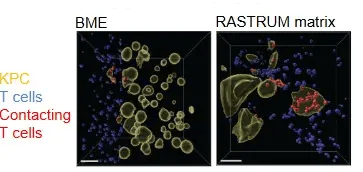
In immuno-oncology applications, for example, immune cells must be able to infiltrate the matrix, migrate through the surrounding environment, and establish contact with tumor cells. These processes depend on various parameters, including matrix architecture, stiffness, degradability, pore structure, and biochemical signalling. Traditional BME-based matrices, as seen in Figure 1, can limit cell infiltration and migration, as they form dense environments that restrict immune cell movement and limit functional interaction with embedded tissues.
A biologically relevant 3D system must therefore support both tissue-like structural organization and functional cellular movement. If the matrix is overly restrictive, infiltration and interaction may be impaired. Conversely, if the system lacks sufficient structural complexity, it may fail to reproduce the transport constraints and spatial organization observed in vivo. The goal is to create a more in vivo-like environment in order to reproduce physiologically relevant transport and cell-cell interactions.
Why Tunability Matters
A key advantage of tunable matrices is the ability to precisely control the physical and biochemical properties that shape cellular behavior and tissue function. Parameters such as stiffness, composition, degradability, and architecture directly influence transport dynamics, cell migration, and cell-cell interaction, allowing researchers to better reproduce the distinct characteristics of healthy, diseased, or fibrotic tissues.
Importantly, synthetic matrices also improve experimental reproducibility. Traditional biological matrices often exhibit batch-to-batch variability and limited control over physical properties, making it difficult to systematically study how tissue architecture influences biological outcomes. In contrast, synthetic hydrogels enable controlled and reproducible modulation of matrix properties across experimental conditions.
Ultimately, the value of advanced in vitro systems lies not in increased biological complexity, but in their ability to reproduce the dynamic relationship between tissue structure, transport, and cellular function. By generating physiologically relevant gradients and interactions, these models provide a more predictive representation of in vivo biology, enabling more accurate assessment of therapeutic response, immune interaction, and tissue behavior.