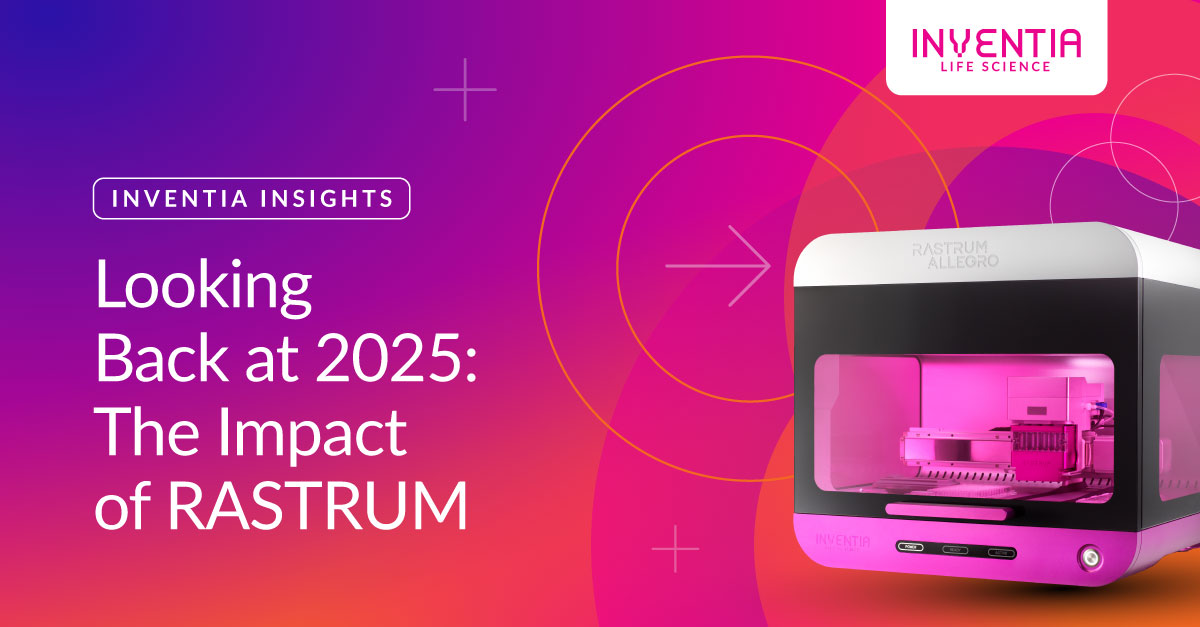
Looking Back at 2025: The Impact of RASTRUM
By Cameron Ferris, Ph.D., Co-Founder and Chief Operating Officer, Inventia Life Science
Each year, I’m reminded just how quickly our field is moving, and how much changes when scientists have access to models that better reflect human biology and run reliably at scale. 2025 was a real inflection point for new approach methodologies (NAMs) in drug discovery, including advanced cell models, organoids, and organ-on-chip systems. Beyond the welcome public discourse, we’re seeing tangible progress: customers are moving advanced cell models from the periphery into the centre of decision-making.
Across oncology, neuroscience, immunology, and precision medicine, teams have used 3D models to reveal biology that can be difficult to capture in traditional systems. More importantly, we’re seeing these models generate reproducible, decision-grade data that can genuinely shift choices inside drug discovery programs. These breakthroughs belong to the researchers who made them, and it’s been a privilege to see RASTRUM support their work.
One of the most significant steps forward for us this year, and one that has helped make that shift practical, was the introduction of RASTRUM Allegro. RASTRUM Allegro was built to make high-quality 3D biology accessible at scale, and it’s been rewarding to watch teams adopt it across discovery programs. Consistency and throughput unlock new questions, and RASTRUM Allegro is already helping researchers explore phenotypes and compound responses with greater confidence. For discovery teams, that reliability is what makes 3D biology practical for screening, triage, and go or no-go decisions.
That momentum also showed up in external recognition for the platform. RASTRUM Allegro was honoured with two Good Design Awards for product design and engineering, and Inventia Life Science was named to the Deloitte Tech Fast 50 Australia. Those acknowledgements reflect the work of our team and the strength of the partnerships around RASTRUM.
The most meaningful validation, though, continues to come from the scientific community. This year, drug discovery teams and research groups used RASTRUM to generate scalable, reproducible 3D data that can stand up in real program decisions.
At Bristol Myers Squibb, researchers developed a reproducible and screenable 3D pancreatic cancer model that maintained uniformity across large assay formats. Their poster at SLAS 2025 in San Diego showed how consistent 3D models can support more reliable phenotypic screening in a disease area where conventional systems often fall short.
At the Garvan Institute here in Australia, investigators created scalable 3D pancreatic cancer models to evaluate novel immuno-modulatory agents. Presented at both SLAS and AACR this year, their work highlighted how 3D models can capture immune-relevant phenotypes that are difficult to resolve in 2D. Those signals matter in immuno-oncology programs where selecting the right mechanisms to advance depends on understanding complex tumour microenvironment interactions.
In paediatric oncology, Professor Maria Kavallaris and the team at Children’s Cancer Institute introduced an approach for generating patient-specific tumouroids using RASTRUM. Their publication in EMBO Molecular Systems Biology showed how this method can overcome longstanding barriers in paediatric cancer research by enabling rapid, higher-throughput drug testing on physiologically relevant models. The potential translational impact is significant.
A study led by Chloe Whitehouse at MSD used RASTRUM to model Alzheimer’s disease with greater fidelity than traditional 2D systems. Their 3D neural cultures captured subtle connectivity and synaptic differences that are important for understanding disease mechanisms and identifying new therapeutic opportunities, while remaining consistent enough to support practical testing workflows.
In women’s health, the University of Technology Sydney created the world’s first bioprinted mini-placentas and used them to study early pregnancy and conditions such as pre-eclampsia. The models, published in Nature Communications, demonstrated how RASTRUM can improve reproducibility and reduce reliance on animal models, while supporting more translational assessment of therapies in this area.
A milestone example of the real-world impact of advanced 3D models came from an ovarian cancer repurposing program that has now progressed into clinical trials, supported by a pre-clinical data package that included results generated in RASTRUM 3D models. Using RASTRUM, researchers produced consistent models incorporating relevant microenvironments and observed drug response patterns that aligned more closely with patient-derived systems. Together, that evidence helped build confidence to move the therapy forward, and it’s a strong illustration of how robust 3D models can inform translational decisions, not just generate interesting biology.
Taken together, these accomplishments show what becomes possible when talented scientists pair their expertise with systems that reflect human biology more faithfully. The impact of RASTRUM is not any single study. It’s the collective progress across disease areas, the new questions researchers can now ask, and the confidence they’re gaining as 3D biology becomes an integral part of discovery workflows because the outputs are increasingly consistent and scalable enough to act on.
I want to thank our team for the dedication and creativity they bring to this work. And I want to thank every collaborator, customer, and researcher who chose to explore what’s possible with RASTRUM this year. Your ambition and curiosity are what drive the real impact.
Looking ahead, we expect the broader industry shift towards NAMs and advanced cell models to continue, and to become even more embedded as a standard part of discovery workflows. Our focus will stay the same: helping teams generate scalable, reproducible 3D data they can trust, and that they can use to make better decisions earlier. Most importantly, we’ll keep working alongside the scientific community and industry partners to ensure researchers have the tools they need to reveal deeper biology and make better, faster drug discovery decisions.
Thank you for being part of this journey. I’m looking forward to the discoveries and translation into better medicines that the next year will bring.