RASTRUM™ Allegro: high-throughput bioprinting for scalable 3D cell models
Move from manual 3D culture setup to reproducible, matrix-embedded 3D cell model generation in standard well-plate workflows.
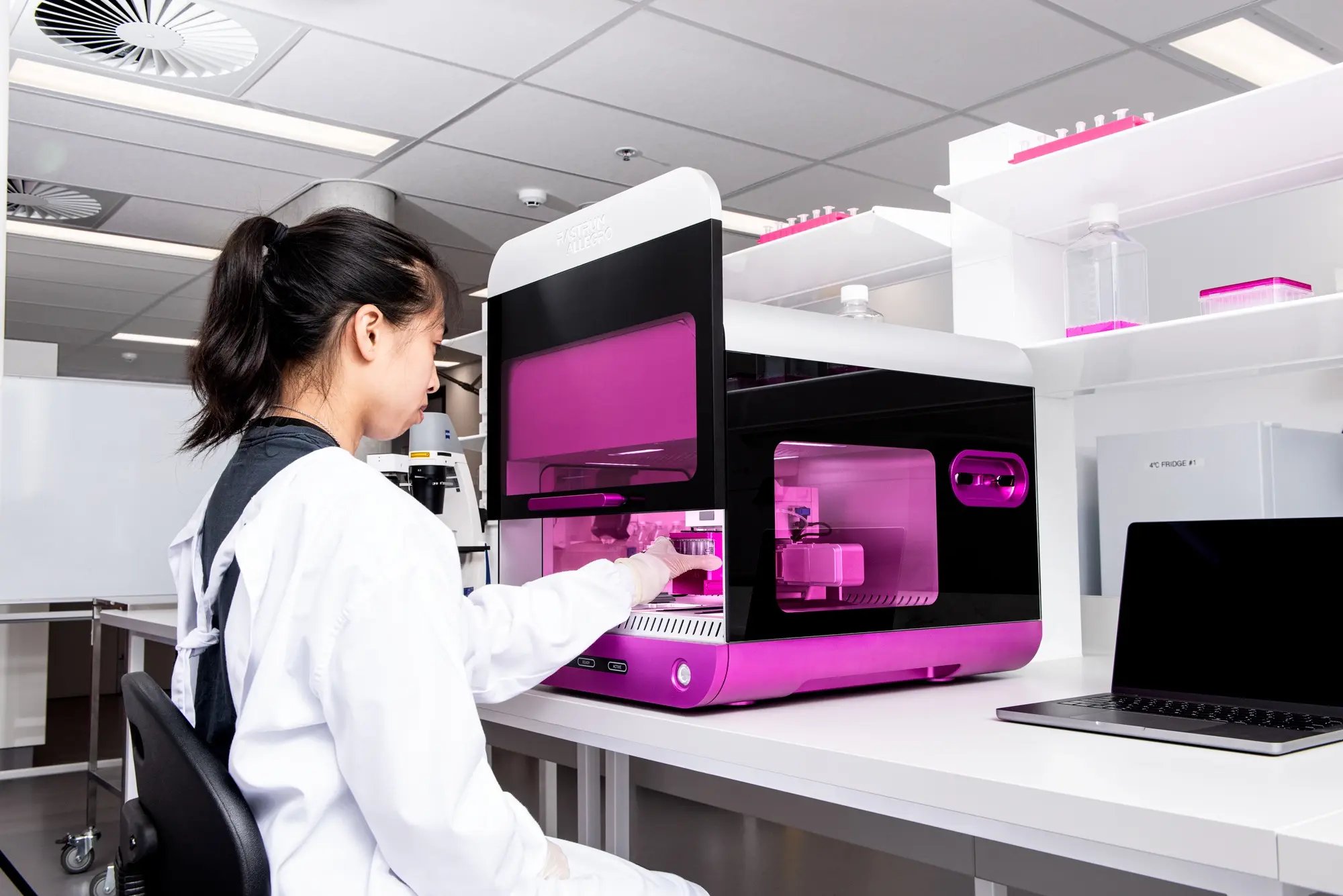

RASTRUM Allegro is a high-throughput 3D bioprinter that uses drop-on-demand technology and precision dispensing to support screening, imaging, treatment-response studies, and downstream analysis.
Why high-throughput 3D bioprinting matters
Manual 3D culture can be useful for exploratory work, but is difficult to reproduce, scale, and connect to routine assays. For teams moving from model development into screening or multi-condition studies, setup variability, sample waste, plate-to-plate differences, and manual handling can limit how confidently results are compared.
RASTRUM Allegro brings high-throughput 3D cell models to a controlled, plate-based workflow. It combines drop-on-demand printing, precision robotics, matrix-embedded models, defined architectures, guided software, and downstream assay compatibility to help teams generate 3D models that can be repeated across plates, runs, and users.
- Create 3D cell models in standard well-plate formats
- Reduce manual variability during model generation
- Generate enough models for high-throughput drug screening and treatment-response workflows
- Support imaging, viability, cytotoxicity assay, high content screening, and molecular readouts where compatible with the model design
- Design novel experimental cell assays to study discrete cell to cell or cell to ECM interactions
- Conserve limited or precious samples by reducing dead volume and waste
What RASTRUM Allegro helps researchers do
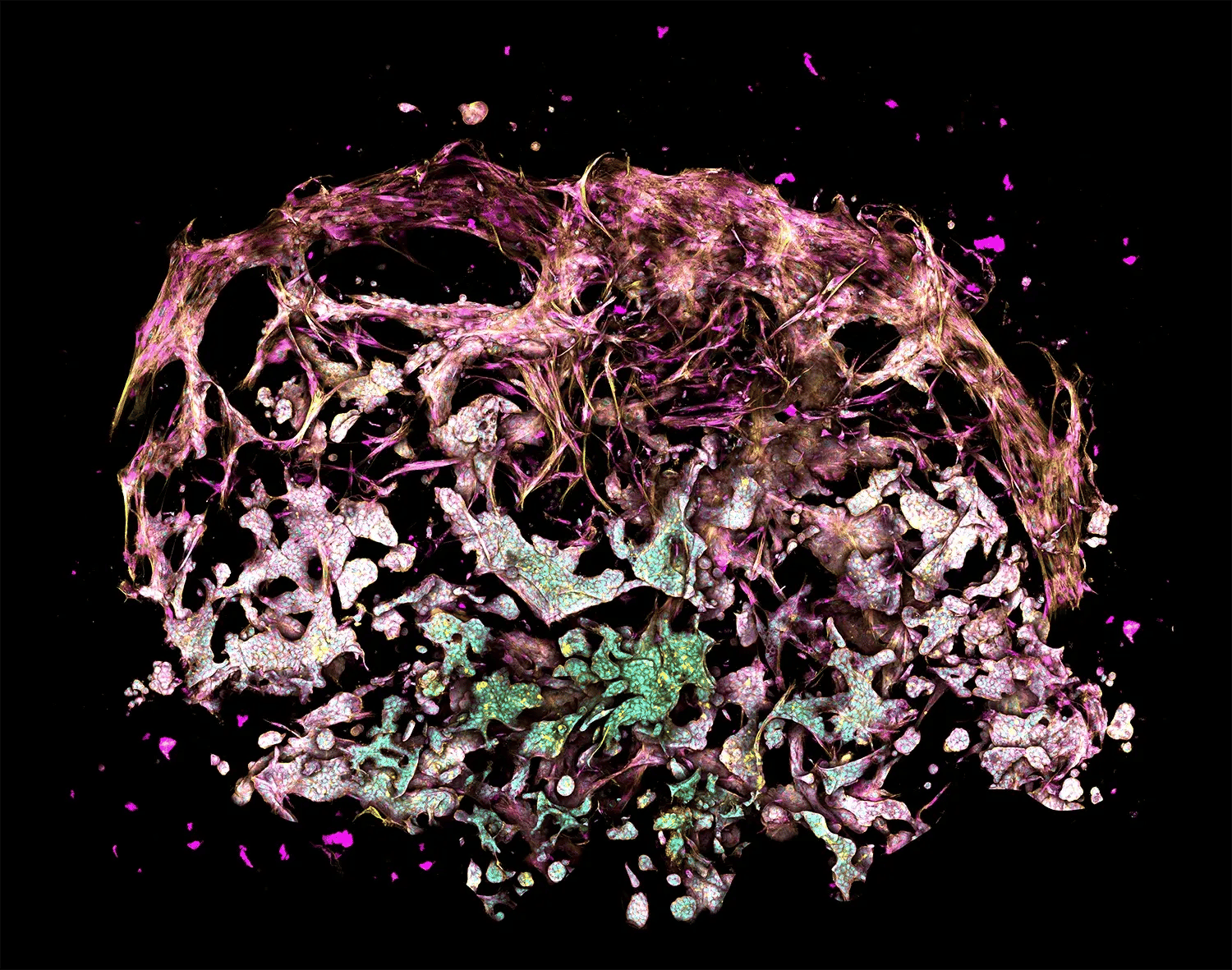
The image depicts a lung cancer tri-culture model made with RASTRUM Allegro. Primary normal human lung fibroblasts (NHLFs) were printed with primary Human Umbilical Vein Endothelial Cells (HUVECs) and A549 lung adenocarcinoma cells using RASTRUM’s Imaging Model architecture. Cells were cultured for 7 days and stained using a PhenoVue Cell Painting Kit (Revvity). Cell nuclei (cyan) were labeled with Hoechst, filamentous actin (yellow) with phalloidin, and membrane glycoproteins (magenta) with concanavalin A.
Build complex biology into scalable workflows
RASTRUM Allegro can support single-cell-type, co-culture, multicellular, and spatially defined 3D models using compatible immortalized, primary, patient-derived, or iPSC-derived cells. Researchers can design models around tumor microenvironment biology, stromal interaction, fibroblast activation, toxicology, drug discovery, personalized medicine, and other applications depending on the cell source, matrix, architecture, culture conditions, and readouts.
Scale 3D cell culture without manual bottlenecks
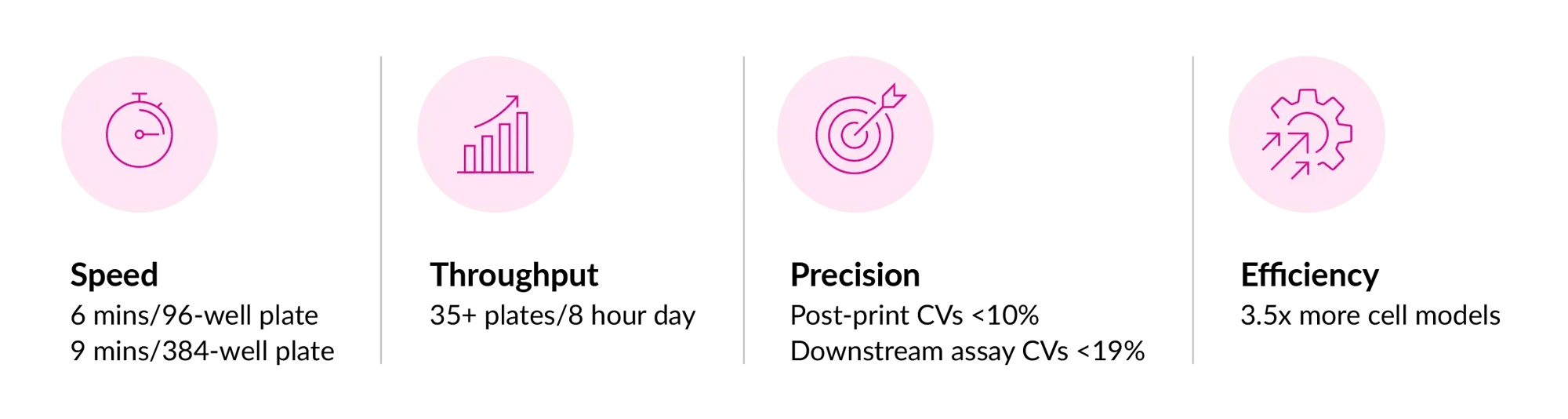
With drop-on-demand printing and precision robotics, RASTRUM Allegro can produce a 96-well plate in 6 minutes and a 384-well plate in 9 minutes for the cell-printing step. Under specified workflows, this can scale to 35+ plates in a single 8-hour day.
Standardize 3D model production across plates and runs

RASTRUM Allegro supports consistent 3D model generation with post-print intra- and inter-plate CVs <10% and downstream assay CVs <19%. This helps teams compare data across plates, runs, treatment conditions, and users with greater confidence.
Get more from limited or precious cell samples
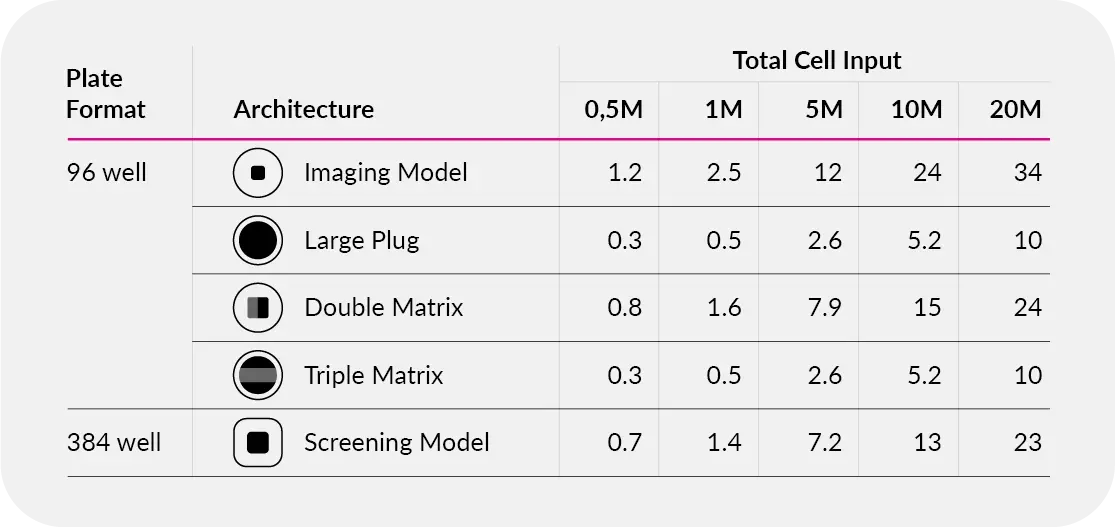
RASTRUM Allegro is designed to reduce dead volume and cell waste, helping researchers produce more 3D models from a given cell input. Depending on the model architecture, plate format, and workflow conditions, RASTRUM Allegro can produce up to 3.5x more cell models from a given sample.
Is RASTRUM Allegro the right platform for your workflow?
RASTRUM Allegro is best suited to teams that need to move 3D biology beyond one-off manual experiments and into reproducible, scalable workflows. It is especially relevant when model generation needs to support screening, imaging, assay development, multi-condition comparisons, or limited-sample research.
- You need to standardize 3D model generation across plates, runs, users, or sites
- You need 96-well or 384-well formats for compatible architectures and workflows
- You need high-throughput 3D cell model generation for screening or assay development
- You need to conserve limited cell input while increasing model output
- You need to create 3D models to investigate complex cell/tissue biology
- You need to connect 3D models to downstream readouts such as imaging, viability, cytotoxicity assay workflows, or molecular analysis
From setup to downstream analysis
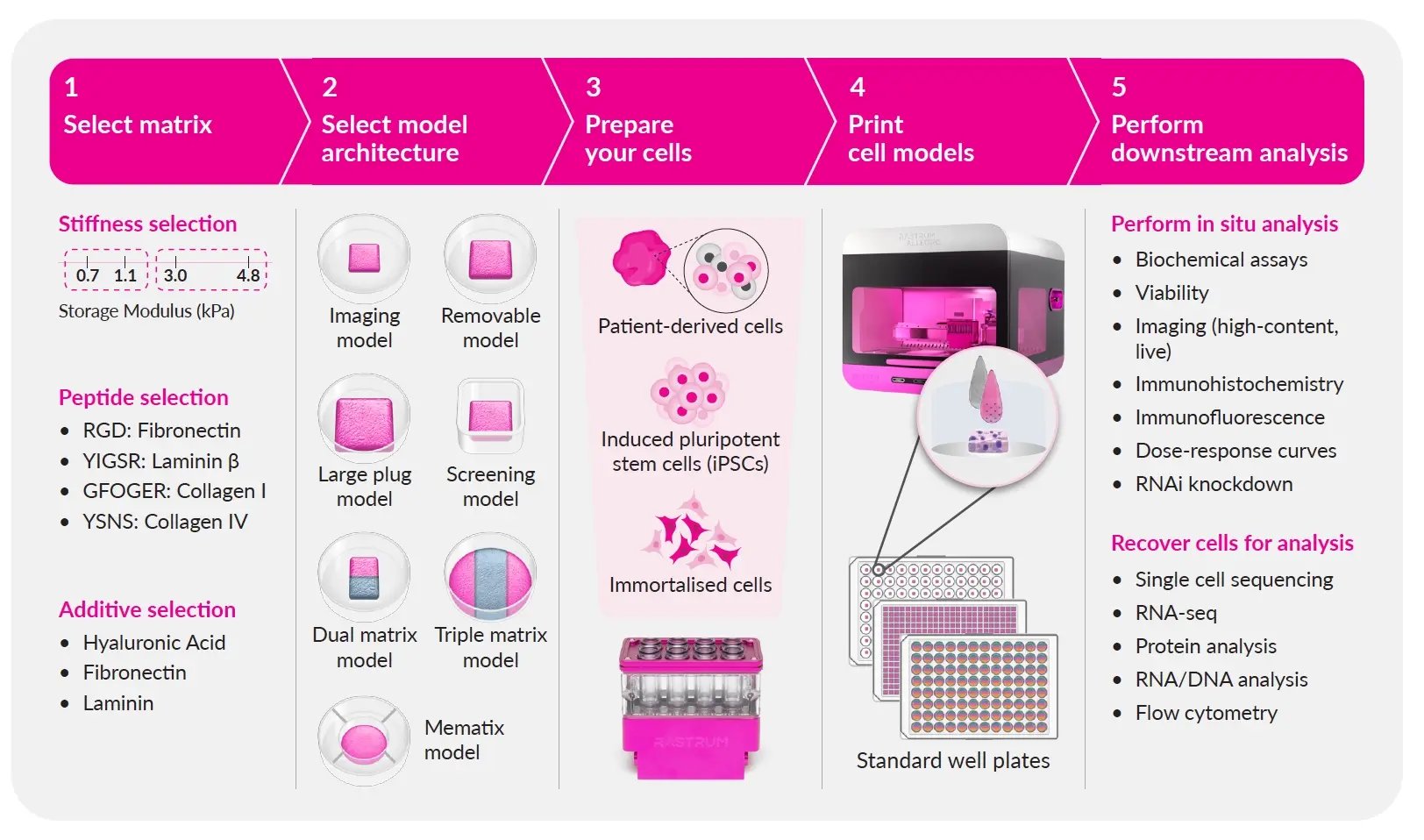
RASTRUM Allegro is part of the broader RASTRUM platform. Matrix selection, architecture selection, software-guided PrintRun planning, automated model generation, and downstream analysis planning work together to help researchers move from 3D model setup to interpretable data.
Select matrix conditions
Explore Matrices
Choose the cell model architecture
Architectures
Prepare selected cells
View the Protocol
Generate 3D cell models
RASTRUM Cloud
Perform downstream analysis
The Platform
Applications for high-throughput 3D cell model generation
High-throughput drug screening and treatment-response studies
RASTRUM Allegro supports high-throughput drug screening workflows by generating reproducible, matrix-embedded 3D models in standard plate formats. Depending on the model and assay, researchers can use these workflows for compound screening, treatment-response studies, cytotoxicity assays, viability readouts, and downstream analysis.
High-content screening and 3D cell imaging
3D cell models are most useful when they can be imaged and analyzed consistently. RASTRUM Allegro workflows can be planned around model architecture, matrix conditions, plate format, staining strategy, imaging depth, and analysis requirements to support high-content imaging and high content screening where compatible with the study design.
Cancer, tumor microenvironment, and co-culture models
RASTRUM Allegro can help researchers build 3D cancer models that incorporate tumor, stromal, vascular, immune, or other relevant cell types where appropriate. These workflows can support studies of tumor-stroma interaction, matrix effects, therapeutic response, and other disease biology questions.
Patient-derived and limited-sample workflows
For teams working with limited or precious cell sources, RASTRUM Allegro can help generate more models from a given input and connect patient-derived or iPSC-derived workflows to scalable experimental designs. Model suitability depends on cell source, matrix conditions, architecture, and readouts.
Resources to empower your research
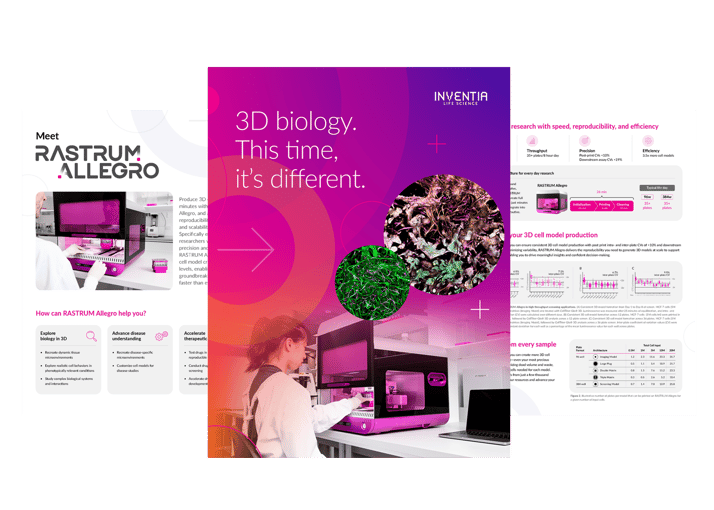
Brochure: RASTRUM Allegro
Get a concise overview of RASTRUM Allegro capabilities, workflow fit, product specifications, and scalable 3D cell model generation.
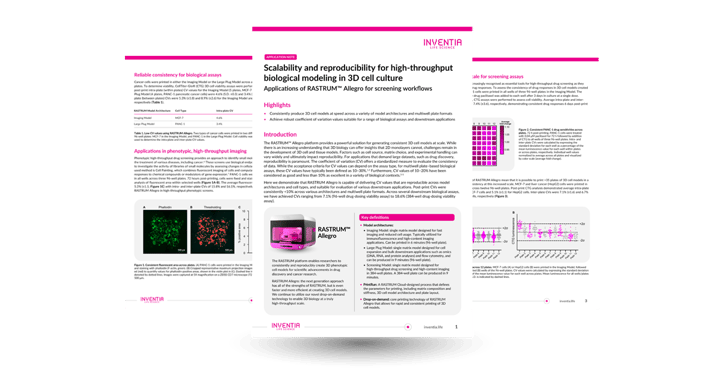
Blog: How RASTRUM Allegro is redefining 3D cell culture
Learn how RASTRUM Allegro was developed to make advanced 3D cell culture more scalable, reproducible, and practical for discovery teams.
FAQs
What is RASTRUM Allegro?
RASTRUM Allegro is Inventia Life Science's high-throughput 3D cell culture bioprinting instrument within the RASTRUM platform. It uses drop-on-demand printing to generate reproducible, matrix-embedded 3D cell models in standard well-plate formats for research applications such as disease modeling, drug discovery, screening, imaging, and assay development.
How is RASTRUM Allegro different from manual 3D cell culture?
Manual 3D culture can be difficult to reproduce, scale, and standardize. RASTRUM Allegro uses drop-on-demand printing and precision dispensing to reduce manual handling, standardize setup, and generate 3D models across compatible well-plate formats with greater consistency.
How fast can RASTRUM Allegro print 3D cell culture plates?
RASTRUM Allegro can print a 96-well plate in approximately 6 minutes and a 384-well plate in approximately 9 minutes for the cell-printing step. Total workflow time also includes initialization, cleanup, protocol steps, model architecture, and experimental setup.
What throughput can RASTRUM Allegro support in an 8-hour day?
RASTRUM Allegro can support 35+ 384-well plates in an 8-hour day under specified workflows. Actual throughput depends on plate format, selected architecture, cell model, protocol steps, and workflow design.
How reproducible are 3D cell models produced with RASTRUM Allegro?
RASTRUM Allegro supports consistent 3D model generation with post-print intra- and inter-plate CVs <10% and downstream assay CVs <19%. Reproducibility depends on the selected model architecture, matrix, cell type, plate format, protocol, and downstream assay.
What plate formats, cell types, and model types does RASTRUM Allegro support?
RASTRUM Allegro supports standard well-plate workflows, including 24-well, 96-well, and 384-well formats for compatible model architectures. It can support single-cell-type, co-culture, multicellular, and spatially defined 3D models using compatible immortalized, primary, patient-derived, or iPSC-derived cells. Suitability depends on cell compatibility, matrix, architecture, culture conditions, and readouts.
How does RASTRUM Allegro help conserve limited or precious cell samples?
RASTRUM Allegro is designed to reduce dead volume and cell waste so researchers can generate more models from limited input. Depending on model architecture, plate format, and workflow conditions, it can produce up to 3.5x more cell models from a given cell input.
What matrix conditions can I choose with RASTRUM Allegro?
What do I need to start printing with RASTRUM Allegro?
A typical workflow starts with selected cells, a suitable RASTRUM Matrix, a compatible cell model architecture, the chosen plate format, culture media and reagents, and a downstream assay plan. RASTRUM Cloud supports PrintRun planning and protocol generation, while Inventia can help guide matrix, architecture, and workflow selection.
Is RASTRUM Allegro for clinical or diagnostic use?
RASTRUM Allegro is intended for research use only and is not for use in diagnostic procedures. It is designed for research applications such as disease modeling, drug discovery, assay development, high-content imaging, and screening workflows.